After my mother died, I started volunteering at a hospice because I could not bear going home to an empty house. That was where I met Nathan, a dying man with no visitors, no emergency contact, and one final request that should have made me walk away.
Two years after my mother died, I started volunteering at a small hospice outside town.
I told people I wanted to help.
The truth was that I needed somewhere grief could exist without anyone asking when I planned to move on.
That was where I met Nathan Cole.
He was fifty-nine, sharp-eyed, and annoyed by almost everything. He hated weak coffee. He hated daytime television. He hated when nurses called him brave.
Most patients had flowers, photographs, or relatives who arrived carrying food.
Nathan had one leather bag and no emergency contact listed.
During my second shift, I brought him coffee from the cafe across the street.
He took one sip.
“You remembered cream in my coffee.”
“Complaining does not guarantee anyone listens.”
“It does when you are impossible to ignore.”
That earned the first smile I saw from him.
A few days later, the volunteer coordinator stopped me in the hall.
“Why?”
“He said you remind him of someone.”
I should have asked more questions.
Instead, I started visiting him before I signed out.
Nathan told stories in pieces. He had washed dishes, driven delivery trucks, and spent most of his life running a diner.
Whenever I asked whether he had children, he changed the subject.
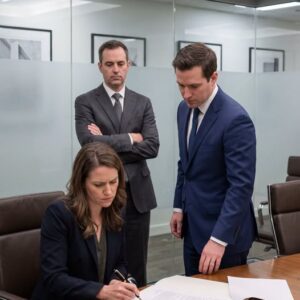
Once, while I was doing a crossword beside his bed, a man in a dark suit appeared in the doorway.
Nathan’s face changed immediately.
The man held up a folder.
“Your signature.”
Nathan took the papers without introducing us.
The man glanced at my coffee, then at the crossword book between us.
For one second, something hard crossed his face.
“This is Eric,” Nathan said. “He handles my paperwork.”
Eric gave me a restrained nod.
Then Nathan dismissed him without another word.
I remember thinking Nathan treated him like an employee who had stayed too long.
One rainy evening, Nathan reached for my hand.
“That sounds dangerous.”
“Pretend you are my daughter until I am gone.”
I stared at him.
Nathan looked toward the window.
My mother had raised me alone.
She never told me my father’s name. After she died, I found no photographs or documents identifying him.
She had only said he chose fear over us.
Nathan’s request should have disturbed me.
Instead, it touched the oldest wound I had.
I forced a smile.
“Well then, hello, Dad.”
Nathan laughed until he coughed.
I reached for the call button.
“You are already demanding.”
“I have lost time to make up for.”
For six weeks, we built a small, borrowed family.
I brought him coffee. He saved crossword clues for me. I pushed his wheelchair through the garden while he criticized flowers he had never planted.
The hospice approved two outings after Nathan signed medical releases.
The first was to Millie’s Diner.
The manager greeted him by name.
“Good to see you, Nate.”
Nathan shrugged when I looked at him.
“I used to work here.”
We sat in a corner booth.
A waitress brought Nathan coffee without asking what he wanted.
He ordered two slices of apple pie.
“Expecting company?” I asked.
The second outing was to the ocean.
I helped him across the sand. He removed his shoes, pressed his feet down, and closed his eyes.
“Worth it?” I asked.